3Traffic Management Measures
3.1.1 Where there is a risk that vehicles will deposit mud and debris on the public road in the vicinity of construction site accesses, wheel cleaning facilities will be provided. The condition of the adjacent public road will be monitored and if mud or debris is found to be present, measures such as road sweeping will be put in place by the Principal Contractor to secure its removal with minimal delay.
3.1.2 Appropriate signage will be provided on the approach to construction site accesses to warn of turning and/or slow-moving vehicles. The design and siting of access signage will be agreed with THC prior to the start of work at each work site. The signage can also be placed at the exit of construction site accesses to instruct construction traffic to follow the designated route.
3.1.3 The Proposed Development will include widening and additional passing places along single-track minor roads to facilitate HGV movements and to enable vehicles to safely pass each other. This mitigation will be refined through detailed design as part of MSC following PPP consent.
3.1.4 Where additional passing places are to be provided, these will be to an adoptable standard. By constructing to an adoptable standard, the passing places can be adopted by THC as permanent improvements (or removed as appropriate) should THC to consider such measures to be beneficial.
3.1.5 Once a construction site access is no longer required, the access will be removed and the road network in the vicinity of the access returned to its original condition.
3.1.6 Relevant details or contact numbers will be on display at appropriate locations along the PPP Application Boundary for the general public to raise concerns in relation to traffic management.
3.1.7 There may be a need to provide traffic management measures at some accesses and along some routes to the accesses. This may be required for various reasons and the type of traffic management measures to adopt will depend upon the location on the road, the nature and level of traffic on the road and what is served by the road, as well as the alternative routes available and whether utilised by other users e.g. cyclists and equestrians. Some examples of these traffic management measures are set out below.
- Where requisite visibility splays cannot be provided at an access, traffic on the road may be temporarily stopped to allow HGVs to exit safely or three-way portable signal control may be temporarily installed.
- Where road geometries are too narrow to safely accommodate turning HGVs, traffic on the road may be temporarily stopped to allow HGVs to exit an access safely or three-way portable signal control may be temporarily installed.
- Where road geometries are too narrow to safely accommodate HGVs passing an oncoming vehicle, shuttle working may be temporarily installed.
- Where road geometries are too narrow to accommodate simultaneous turning movements through junctions, three-way portable signal control may be temporarily installed at T-junctions or four-way portable signal control temporarily installed at crossroads.
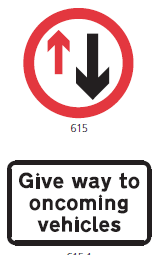
3.1.8 Where traffic on the road is stopped, this could be via temporary portable signals or via manually operated STOP/GO signs. Where shuttle working is used, where one direction of travel receives priority over the other direction of travel along the road, this could be via temporary portable signals or via give way signs.
3.1.9 Some example layouts of these traffic management measures and features are shown in Figure 3.1 Open ▸ to Figure 3.7 Open ▸ . These examples are taken from the Traffic Signs Manual (2009), Chapter 8, Part 1 – Traffic Safety Measures and Signs for Road Works and Temporary Situations. The extracts are generic in nature and not designed to be specific to a given location or circumstance but designed to be implemented in accordance with the advice contained within the document.
3.1.10 The Health and Safety at Work, etc. Act 1974 and The Management of Health and Safety at Work Regulations 1999 require all clients, employers and employees to establish and maintain safe systems of work. All traffic authorities, statutory undertakers and contractors must give due attention to the detailed traffic management arrangements at road work sites and incident locations to ensure the safety of the public and of their own employees at these obstructions.
3.1.11 It is essential for the safety of all concerned that uniform and consistent procedures are adopted. Chapter 8, Part 1 of the Traffic Signs Manual is intended to provide a standard of good practice for the signing and marking of obstructions, as well as for the temporary traffic control necessitated by such obstructions of the road network. The standard described is a minimum, which should always be achieved. At difficult sites, such as those where the on-site risk assessment has shown that the level of risk is above normal, further signs and other equipment will be necessary.


3.2Road Crossings
3.2.1 It is envisaged that major road crossings will be undertaken using HDD or other trenchless techniques. The details of trenchless techniques are set out in Volume 1, Chapter 3: Project Description of the Onshore EIA Report.
3.2.2 This method of cable laying means that there is no disturbance to other users of the public road, such as no shuttle working or road closures, except for material delivery and arrival/departure of construction staff.
3.2.3 There will be some locations whereby the haul road crosses the public road and where traffic management measures will be required or where works are required to expose existing utilities. The traffic management measures to be used will depend on the location of the road crossing, the nature and level of traffic on the section of road being crossed, what is served by the road link, if alternative routes are available and, if used by others (e.g. cyclists and equestrian).
3.2.4 Figure 3.1 Open ▸ , Figure 3.2 Open ▸ and Figure 3.5 Open ▸ show indicative priority, STOP/GO and signalled shuttle working. On roads with light traffic flow, shuttle working can operate on a priority basis or be managed manually without the need for traffic signals. On busier sections of road, it is expected that temporary signals will be used.
Agreement, Management and Advance Notification
3.2.5 Where traffic management measures are required, these will be agreed in advance with THC and Transport Scotland. Temporary road closures, introduction of one-way roads and diversions will be advertised in advance and alternative routes indicated through signage.
3.2.6 Measures will be put in place so that no unauthorised access is gained to construction sites from the public road at crossing points and that adjacent work sites are secure.
3.2.7 Works within the public road will be reinstated to an equivalent standard as existed prior to the commencement of the works and agreed with THC and Transport Scotland.
Haul Road and Crossings with a Public Road
3.2.8 A haul road will be constructed within the Onshore Export Cable Corridor and 400 kV Cable Corridor to enable HGV access to undertake trenching works and install the cables, with gaps only at some trenchless technique locations and road crossings. The haul road will enable vehicles to move along the Onshore Export Cable Corridor and 400 kV Cable Corridor and relieve the need for construction traffic to rely on longer sections of the road network during construction.
3.2.9 The haul road will operate with a low speed limit for the safety of workforce and plant operatives in the vicinity. Where the haul road crosses a public road, traffic management measures will be used for the safe crossing of construction vehicles.
3.2.10 An example layout is set out in Figure 3.8 Open ▸ , which is taken from the Traffic Signs Manual (2009). The precise layout for each will be confirmed by the Principal Contractor based upon the specific requirements of each crossing location.
3.3Management of Highway Safety
Existing Accident Record
3.3.1 An analysis of Personal Injury Accident (PIA) data for the local road network has been undertaken in Volume 1, Chapter 15: Traffic and Transport.
3.3.2 PIA data has been obtained from Transport Scotland and CrashMap for the latest available five-year period to consider road safety across the local road network.
3.3.3 The PIA data obtained from Transport Scotland covers the five-year period between 01 January 2020 and 31 December 2024 for the sections of A9 and A99 within the vicinity of the PPP Application Boundary. The PIA data obtained from CrashMap covers the five-year period between 01 January 2019 and 31 December 2023 for all other parts of the road network.
3.3.4 The PIA data has been interrogated for all parts of the road network to identify clusters of injury accidents within the relevant five-year period where a cluster of injury accidents has been defined as a site where three or more injury accidents have occurred within a 100 m radius of each other within a five-year period.
3.3.5 An analysis of the PIA data obtained from Transport Scotland for the A9 and A99 and from CrashMap for all other parts of the road network identified no clusters of injury accidents within the relevant five-year period.
Monitoring and Mitigation for the Proposed Development
3.3.6 HGV injury accidents and near misses of construction vehicles for the Proposed Development will be monitored to identify whether there are safety deficiencies in the road network due to an increase in HGV movements during construction of the Proposed Development. If local mitigation measures are required, these will be agreed with THC and incorporated into the final CTMP.
Road Condition Survey
3.3.7 A road condition survey will be undertaken of the roads where it is considered that the passage of construction HGVs may cause deterioration of the road. These roads will be agreed with THC as part of the final CTMP. The schedule of roads to be surveyed will be agreed with THC prior to construction activities taking place.
3.3.8 Once construction activities have ceased in each location, the condition survey of the relevant section of road will be repeated to identify significant changes in the condition of the road. The results will be discussed with THC and where it is agreed that damage has resulted from the passage of HGVs associated with construction of the Proposed Development, a financial contribution will be discussed with THC to cover the cost of repairing the damage, or the repair will be facilitated by Ayre Offshore Windfarm Limited.
4Implementation and Monitoring of the CTMP
Implementation
4.1.1 The final CTMP will be agreed with THC prior to commencement of construction activities and reviewed in consultation with the appointed Principal Contractor and construction teams. All contractors will be required to comply with the measures in the final CTMP as a condition of their employment.
Compliance
4.1.2 With oversight from the Client, the Principal Contractor will be responsible for compliance with all the monitoring plans, including the final CTMP. The Principal Contractor will be responsible for ensuring that all contractors are aware of the requirements of the final CTMP and of the monitoring obligations. The Principal Contractor will be appointed before the start of construction activities and will continue throughout the entire construction period of the Proposed Development. The Principal Contractor will be the central point of contact for all monitoring processes during construction of the Proposed Development and will be responsible for liaising closely with THC and Transport Scotland throughout the construction works.
4.1.3 The Principal Contractor will be responsible for implementing a system whereby construction HGVs are identifiable from other traffic on the road network and include Global Positioning System (GPS) tracking to enable the routes of construction HGVs to be monitored where necessary.
4.1.4 Where possible, data will be collected from construction HGVs that are fitted with monitoring devices, such as GPS tracking, to record their routes, timing and speeds, which will be available to aid compliance investigations.
4.1.5 The registration numbers of all construction HGVs will be recorded. The use of data from tracking devices and recording registration numbers will assist with the enforcement of the final CTMP.
4.1.6 Establishing this central point of contact will mean that the responsibility of construction activities falls to a minimal number of individuals facilitating clarity of responsibility and effective communication.
4.1.7 All monitoring activities and responsibilities will be agreed with THC. The final CTMP will include contact details of those responsible for the final CTMP and a clear schedule of monitoring activities and timescales.
Monitoring Records
4.1.8 The final CTMP will be a live document which will be updated as required during the construction period. The Principal Contractor will be responsible for monitoring, with the results of this monitoring fed back to be included into the final CTMP. Auditing and corrective action will also be monitored by the Principal Contractor such that the construction activities are being undertaken in accordance with the final CTMP.
4.1.9 The procedure for addressing breaches and ensuring corrective action is given below.
- A log will be used to record details of traffic and transport related incident and/or non-compliance with the final CTMP.
- A log will be used to record inadequacy because of monitoring, inspection, surveillance and compliance.
- A log will be used to record actions taken and allocated to the appropriate person, along with a timescale for the action to be undertaken.
4.1.10 Records of the above will be retained as the responsibility of the Principal Contractor throughout whole construction period of the Proposed Development. These will be maintained either in hard copy or electronically so these can be accessed easily.
Enforcement and Corrective Measures
4.1.11 If the Principal Contractor is made aware of a potential breach of the final CTMP (except where otherwise agreed with THC, or in the event of an emergency), the Principal Contractor will be required to investigate the circumstances and create a report for THC. THC will then review the information, request further clarification (if required) and confirm to the Principal Contractor if a material breach of the final CTMP has occurred.
4.1.12 If the breach is found to be material, the below three stage process will be followed.
- Stage 1
- THC confirms a breach and requests that the Principal Contractor considers the data and concerns. THC and the Principal Contractor will then agree the extent of the breach of the final CTMP and agree actions to be taken.
- Stage 2
- If a further material breach of the CTMP is identified, the Principal Contractor will be given another warning and will be required to produce a plan to outline how the issue will be rectified and what additional mitigation measures are to be implemented.
- Stage 3
- Should further breaches take place, the Principal Contractor will be required to remove the relevant party from site and the contractor/supplier will receive a formal warning. Continued breaches by individuals of the contractor/supplier may be treated with formal dispute procedures of the contract.